Category

Publications
Cacao production is facing challenges of low productivity due to low soil fertility and climate change. Agroforestry and organic farming are potential sustainable and climate-resilient alternatives, but they are often associated with lower yields compared to monocultures and conventional farming. Despite their potential, empirical data on the long-term productivity of cacao cultivated in complex agroforestry...
Read More
Cacao Nacional Boliviano (CNB), the native cacao germplasm group in the Bolivian Amazon region, possesses distinct morphological, genetic, phenological and organoleptic characteristics. It is highly sought after in the global fine-flavour chocolate market, and has importance for conservation of cacao genetic diversity. However, CNB cultivation is minor and yield levels low. Aiming to develop profitable...
Read More
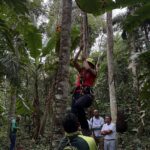
Light access is the primary factor affecting yields in cacao-based agroforestry systems (CAFS). While CAFS ecosystem services provision is extensively documented, research on improving light access in CAFS remains scarce. Shade canopy pruning, a developing technique in Latin America, is part of the long-term SysCom Bolivia trial. It is undertaken twice a year, at the...
Read More
Agronomy for Sustainable Development
A recent study by Armengot et al. compared four cocoa production systems: agroforestry and monocultures, both under organic and conventional management, over the first five years after establishment. While monocultures produced 41% higher cocoa yields, agroforestry systems generated significantly higher total revenues due to the sale of by-crops like bananas and plantains. Importantly, the return...
Read More
frontiers in sustainable food systems journal
A recent study by Orozco-Aguilar et al. highlights the contributions of the CacaoFIT network—a collaborative effort among agronomists, researchers, and practitioners—to sustainable cocoa farming in Latin America and the Caribbean. By assembling data from 25 experimental field trials across diverse agroecosystems, the network explores various cacao cultivation models suitable for smallholder farmers. Key findings indicate...
Read More
frontiers in sustainable food systems journal
This study finds that using locally-selected cocoa clones can significantly boost cocoa yields. Conducted over five years in Bolivia, the research compared the performance of local clones against widely-used international varieties and found that local clones produced two to five times more cocoa beans. These clones also had larger pods and therefore required fewer pods...
Read More
This study examines how pruning shade trees impacts cocoa yields and income in agroforestry systems in Bolivia. Farmers who pruned their shade trees experienced yield increases from 430 kg/ha to 710 kg/ha of dry cocoa beans. This improvement was attributed to better flowering and pod production due to enhanced light availability. While pruning significantly increased...
Read More
A recent study conducted in the Alto Beni region of Bolivia compared different cocoa cultivation systems to assess their impact on carbon stocks and tree diversity. Researchers examined cocoa monocultures, simple agroforestry systems, successional agroforestry systems, and fallow land as a control. The findings revealed that successional agroforestry systems had the highest carbon stocks and...
Read More
This study compares cocoa monocultures and agroforestry systems under organic and conventional management over a decade in Bolivia. The findings reveal that while monocultures excel in cocoa-specific yields, agroforestry systems produce significantly more total food and provide greater nutritional quality, feeding more people per hectare and working hour. Agroforestry systems also require less non-renewable energy...
Read More
1 2 3