Farming does more to the environment than emit carbon. It acidifies soils, loads waterways with nutrients, occupies land, and releases toxic compounds (1). Other industries handle this breadth of impact with a single tool: life cycle assessment. So how well does LCA cope with something as tangled as an agroforestry plot?
LCA measures the environmental impacts of a product across its life span within a defined boundary, covering air, water, and land depending on the impact assessment method chosen (2,3). It is well established in manufacturing, mining, and oil and gas. In agriculture it rarely leaves the research setting.
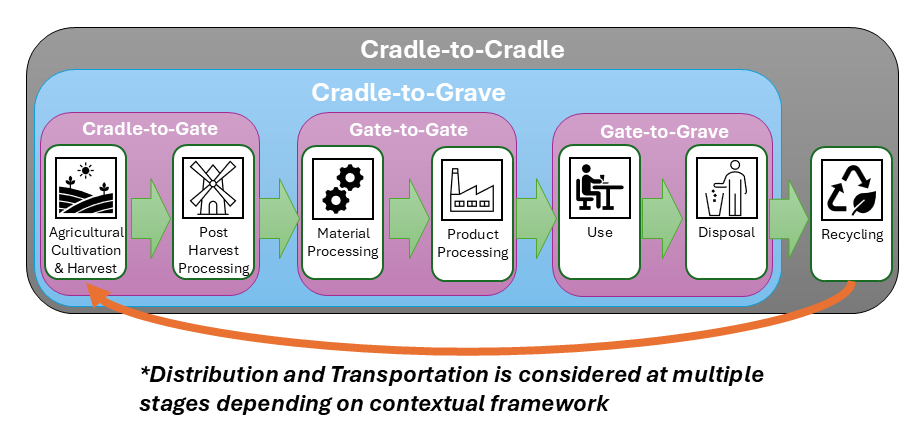
Agri-business tends to reach for carbon accounting instead, usually the GHG Protocol. That gives you emissions and nothing else (4). And on the academic side, there is plenty of LCA work on monocrops but very little on polycultures, especially comparative work on agroforestry (5). However, the capabilities of LCA in complex agricultural set ups have improved over the past decade.
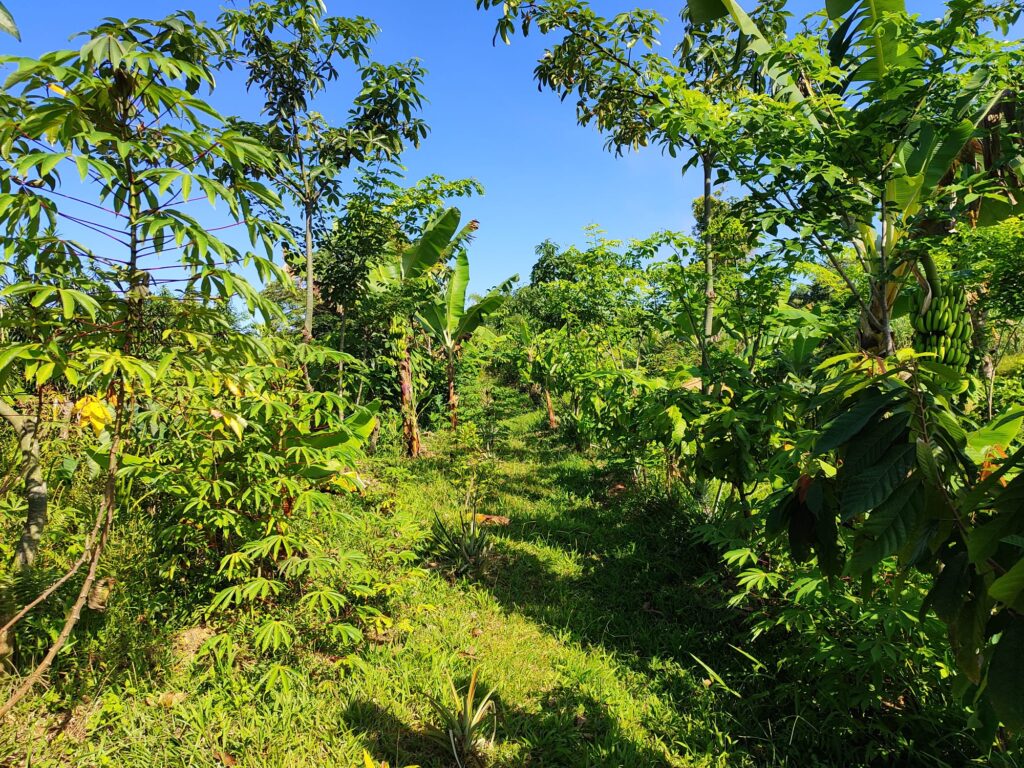
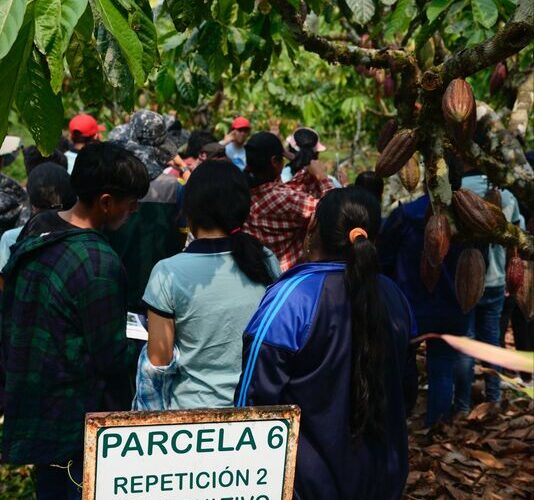
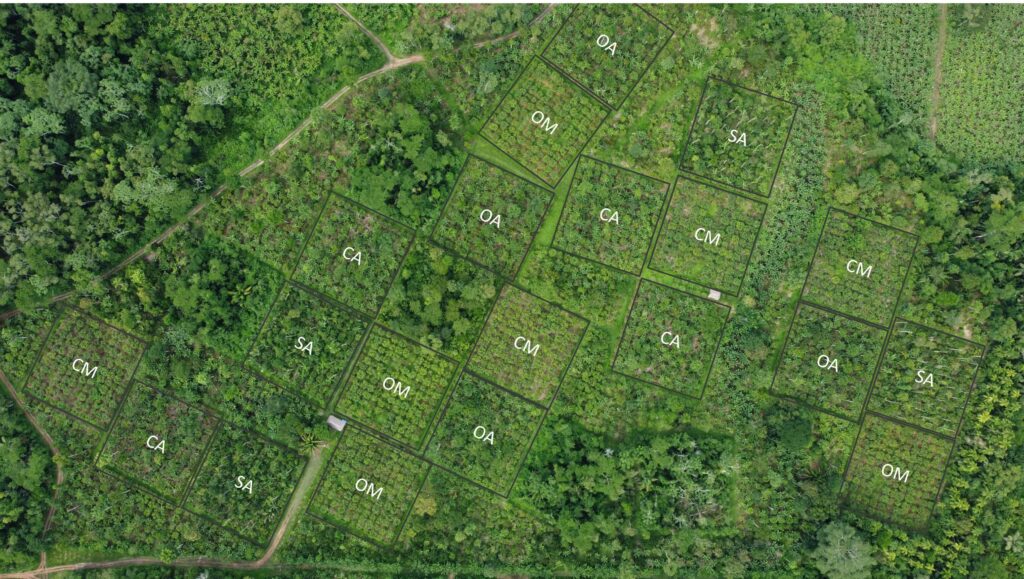
A master’s thesis by Nabila Budiaki tested how well LCA suits agroforestry, using SysCom field data. It compared cocoa grown in monoculture (MONO), conventional agroforestry (CAF), and dynamic agroforestry (DAF), with organic and inorganic management variants for MONO and CAF (6). Two functional units were used: one tonne of cocoa produced, and one hectare-annum of land occupied.
Indicator categories covered land use, GHG emissions, eutrophication, acidification, ecotoxicity, photochemical ozone formation, water scarcity, and resource scarcity. A scenario analysis modelled sprinkler irrigation against the current rain-fed baseline, LCA carbon results were checked against GHG Protocol accounting, and the whole thing was cross-referenced with published studies.
The effect of yield shows up clearly. DAF came out lowest-impact across both functional units, with CAF-Org second. The worst performer depended on which unit you used. Per tonne of cocoa, MONO-Org lost: yields were low relative to inputs, so the burden of growing cocoa and cassava was spread across very little product. Per hectare-annum, CAF-Inorg lost, because its raw footprint is large. But that same system produced the most cocoa, which diluted its per-tonne burden. For smallholders and buyers, that is a direct line from input spend to wasted effort.
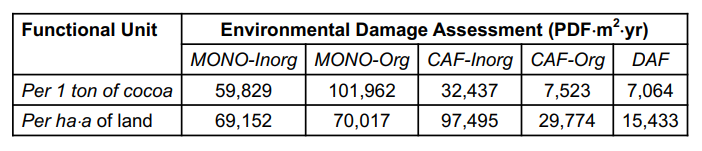
Two functional units keep the argument honest. Read one way, the results say organic amendments are worse for the environment than mineral fertiliser. The land-based unit offers another interpretation by stripping out the yield effect and shows impact as a function of application intensity, so nobody walks away with the conclusion that organic systems are inherently worse.
Scenario work is fast and effective. Major decisions can be simulated before heading into the fields. From the study, adding sprinklers to the model showed water scarcity spiking alongside higher CO2-eq emissions and resource depletion. Organic systems were far more sensitive, landing 10 to 40 times above baseline, while inorganic systems rose by at most a factor of 3. That is the kind of thing worth knowing before you dig the trenches.
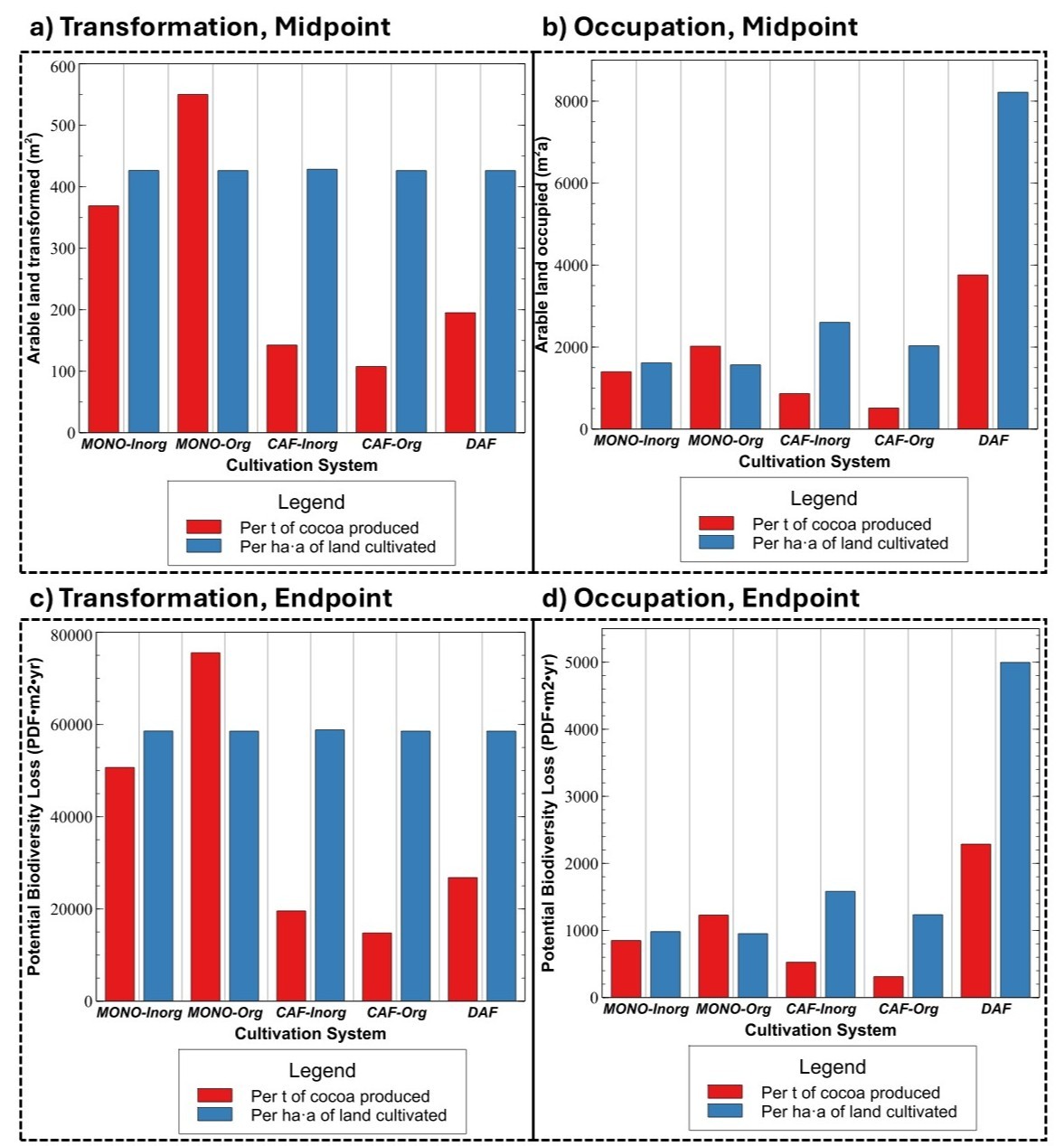
Understanding Land Use Implications. Most indicators produced plausible numbers, several within range of published studies where comparable. Land use did not. Potential biodiversity loss from land occupation was the one category where DAF scored worst despite on-the-ground showing the opposite. In all existing studies covering the SysCom project, DAF was clearly the most bio-diverse; from floral diversity, to macrofauna like birds, and even microorganisms such as bacteria and fungi. Land transformation did not fare any better, with DAF showing higher potential biodiversity loss per tonne of cocoa than the CAF systems, while per hectare-annum every system returned the same value.
The LCIA data explains why. Transformation to and occupation by all permanent crop categories carry a characterisation factor of 0.77 m2 and 0.77 m2a. Annual fallow carries 0. An established, continuously productive agroforestry plot is therefore scored as worse for biodiversity than bare fallow ground. Two failures are stacked here: the method has no way to represent the biological mechanisms that make DAF more diverse, and it has no land use class finer than “permanent crop,” so a shaded multi-strata system and a cocoa monoculture are arithmetically identical.
Carbon for crediting. LCA and GHG Protocol results sat in a similar range and mostly moved together, with CAF-Inorg the exception due to its industrial footprint. But LCA typically credited more sequestration and less emissivity. Carbon markets want the conservative number, with documented justification and a regime for handling variability, so the LCA figures are not bankable as credits.
Uncertainty. There is no consensus on how to do agriculture LCA. Agroforestry studies are scarce, and the few that allow comparison often use different LCIA methods. Allocation is a real problem: ISO 14044 asks practitioners to use physical allocation and treat economic allocation as a last resort, but physical allocations that map cleanly onto impact pathways are hard to build in intercropped systems, and economic allocation ties environmental burden to volatile prices that have nothing to do with science.
Carbon accounting has an edge over LCA with the availability of numerical errors and ranges. In LCA, sensitivity analysis is the preferable choice when assessing numerical uncertainty in a system, but it barely applies when the systems being compared are structurally different rather than differing by one parameter. Scenario analysis then becomes the default option, but with no numerical uncertainty to provide.
Not yet at least! While LCA can be a game changer in agricultural LCA, it is too dependent on data sets that are static. While suitable for other industries, agriculture pre-farm gate is much too dynamic to be accommodated for similarly. The physiochemical theory appears sound, especially when estimating CO2-eq emissions. The biological component needs work and as it currently stands, it needs more time to be developed in research settings before being a feasible replacement for carbon accounting in the business sector.