The shade trees they planted years ago to diversify their plots and protect their cocoa have grown tall and dense. What was once a balanced agroforestry system has gradually become overshaded, and cocoa yields have started to decline. Faced with falling production, many farmers reach for the only tool readily available to them: they cut the trees down.
The response is understandable, but it carries a heavy cost. Removing shade trees strips agroforestry systems of their biodiversity, weakens long-term resilience, reduces carbon storage, and pushes farms back toward monoculture — sometimes even driving expansion into new forest areas to recover lost income. The real obstacle isn’t that farmers are unaware of the value of trees, or that they’re reluctant to manage them. In most regions the issue is simpler: the service that could keep those trees standing — specialized pruning at canopy height — is not available.
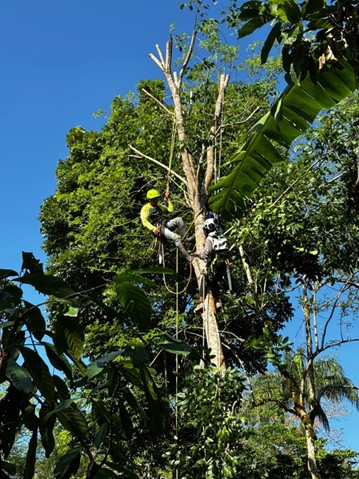
Pruning is often described in the literature as labour-intensive and risky, with cocoa farmers portrayed as reluctant to take it on (1, 2). Field experience tells a different story. Farmers don’t perceive pruning itself as daunting — they perceive overshading as daunting. They want their trees managed. What they lack is access to trained arborists who can climb tall shade trees safely and prune the upper canopy correctly.
How widespread this gap is can be seen in the baseline of recent field research: in a Bolivian on-farm trial reported by Esche et al. (2023), the agroforestry plots evaluated had not had their shade trees pruned in at least ten years (1). The absence wasn’t a choice — it was a default condition created by the absence of a service. Where that service does become available, farmers invest in it. In a recent project in Alto Beni and Palos Blancos, run by ECOTOP with FiBL and Halba and supported by SWISSCO, producers covered 50% of the cost of pruning services themselves. That willingness to pay is the clearest signal that the demand was there all along.
Pruning is the targeted removal of branches to improve a plant’s health, structure, or productivity (3). In cocoa agroforestry, height-pruning of shade trees delivers two distinct benefits that work in tandem.
More light reaches the cocoa. Flowering and fruit production are limited by photosynthetically active radiation. When canopy cover sits above 70–80%, the cocoa layer is starved of the light it needs to flower and form pods. Reducing canopy cover to a more balanced level restores the energy supply the cocoa needs to produce.
The cut biomass becomes mulch. Pruned material doesn’t leave the system — it’s left on the ground, where it decomposes into organic matter. This recycles nutrients, improves soil structure, retains moisture, and supports soil biology. The same intervention that opens the canopy also strengthens the foundation of the system below ground.
Together, these effects mean pruning is not a compromise between cocoa and diversity. It is the practice that makes it economically rational to keep shade trees — and to keep planting more of them.
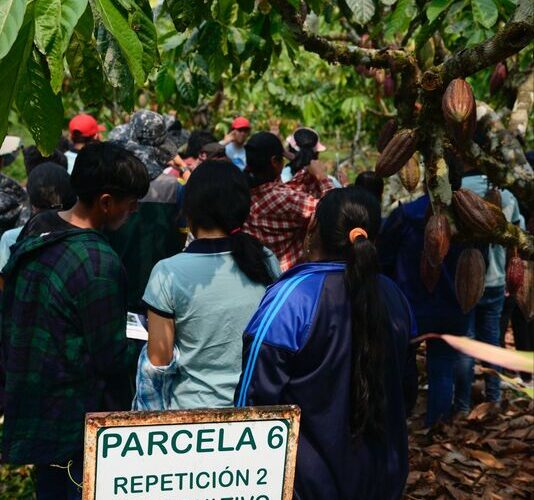
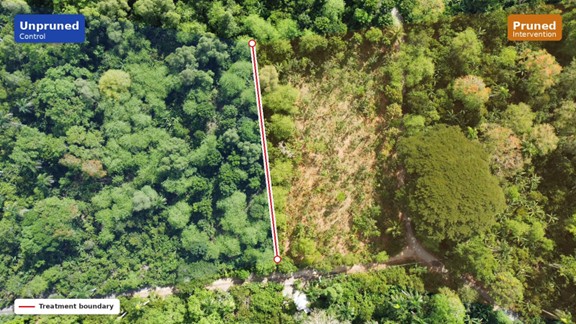
A controlled on-farm trial by Esche et al. (2023) in Alto Beni divided four cocoa agroforestry plots in half, pruning the shade trees on one side and leaving the other side untouched as a control (1). Two years on, the pruned plots averaged 708 kg/ha of dry cocoa beans against 431 kg/ha in the unpruned controls — increases ranging from 28% to 82% across the four sites. The mechanism was clear: flowering rose from 15% to 19% of the maximum, fruit set jumped 31%, and the number of mature pods nearly doubled (from 287 to 497 per hectare). Cherelle wilt rates were unchanged, meaning the extra yield came from producing more flowers, not from holding on to a higher share. Pest and disease incidence did not increase.
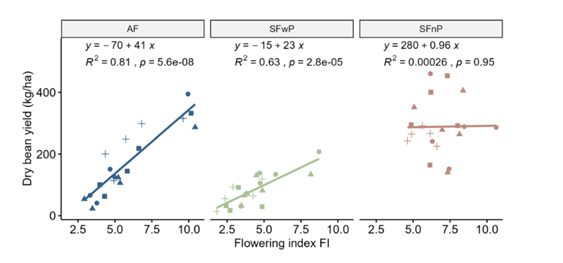
A longer-running comparison published in 2025 by Keller and colleagues makes the point more starkly (4). They tracked three Bolivian systems over a decade: an agroforestry system with annual maintenance pruning (AF), a secondary forest with cocoa where the same pruning was applied (SFwP), and a secondary forest with cocoa left unpruned throughout (SFnP). The relationship between flowering and yield diverged completely between the three. In pruned AF plots, the flowering index explained 81% of the variation in yield (R² = 0.81) — each step up in flowering translated directly into more pods harvested. In SFwP, the relationship held but weaker (R² = 0.63). In the unpruned SFnP plots, the relationship vanished (R² ≈ 0): trees set flowers, but flowering told you essentially nothing about how much cocoa would come off the plot. The system was producing potential it couldn’t turn into harvest.
The intervention requires trained arborists with climbing equipment and the knowledge to prune trees according to species and canopy layer. Esche et al. (2023) modelled whether the resulting yield gain could pay for that work, and at the cocoa prices of the time — around USD 2,340 per tonne on the international market, with an organic premium reaching about USD 3,180 — the answer depended heavily on baseline yields. Farms already producing well could cover the cost from the yield gain alone; lower-yielding farms could not, and the authors argued for sector support to close that gap.
The price environment has since changed substantially. Cocoa surged from late 2023 onward, hitting a record near USD 13,000 per tonne in December 2024 and staying above USD 10,000 through early 2025 (5). Prices have corrected sharply since, but remain elevated relative to the 2012–2022 average of roughly USD 2,500 per tonne. At any price near or above recent levels, a 20–40% yield gain from pruning generates more than enough additional revenue to cover the service within a single harvest cycle on most plots. The borderline cases in the Esche analysis are no longer borderline.
The real bottleneck is upstream of price. In most cocoa-growing regions, even where farmers want pruning and could pay for it, there is simply no business to call. Rural agroforestry zones tend to operate within largely informal economies, where small specialized services rarely formalize, certifications are scarce, and the surrounding infrastructure — companies, trained workers, organized demand — has to be built almost from scratch. Building a service market means literally building service businesses.
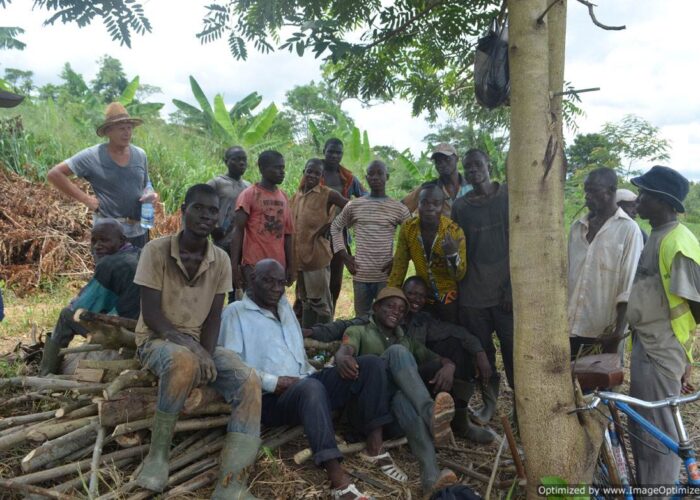
In Alto Beni, that is what is now taking shape. PODAB SRL — Podadores del Alto Beni, “the Alto Beni Pruners” — is a limited liability company formed by young arborists from the region, all of whom are also cocoa farmers and most of whom worked alongside ECOTOP for several years before forming the business. They formalized as a company because the demand from neighbouring producers had grown beyond what informal arrangements could cover. ECOTOP, together with Rapunzel One World Organic Foundation and the SWISSCO-supported intervention with FiBL and Halba, provided the scaffolding: equipment, technical training, and a route to market through the existing producer cooperatives.
The PODAB members are now preparing for International Society of Arboriculture (ISA) certification, an internationally recognized standard for safe and competent tree work. In their first operational phase the team has pruned more than 800 trees across 36 producers and 17 hectares, reducing canopy cover from a 60–95% range down to 25–60% — an average drop of 25–35%. Expected productivity gains for those producers are 20–40%, with most projected to recover their investment within a single harvest cycle. Over a 24-month consolidation phase, the company is targeting roughly 150 producers across Alto Beni and Palos Blancos, while moving steadily toward operating without project subsidy.
The financing structure tells its own story. The producer covers 50% of the service cost; the project contributes 50%. The 50% share is not a permanent subsidy — it is the start-up capital that lets a service market form in a setting where, until recently, no such market existed. As volumes grow and the arborist workforce becomes certified, that share is designed to shrink to zero.
What makes PODAB structurally important is that it pairs two scarce things: agroforestry knowledge — held by people who grew up in cocoa systems — with the technical credentials needed for the work to be safe, professional, and scalable. The farmer who needs his canopy pruned is being served by someone from the same valley who knows what a healthy agroforestry plot looks like, climbs the tree with the right equipment, and can be hired again next season. That combination — local roots, formal company, certified skills — is what was missing before, and what the model is built to scale.
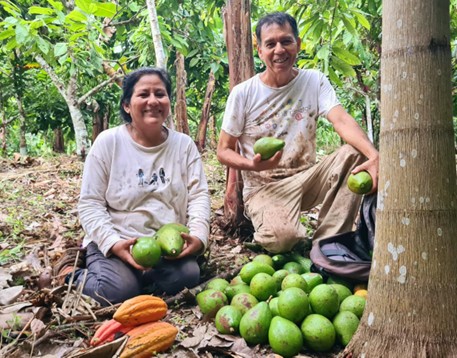
Juana Cuaquira, a farmer in Alto Beni, shows what mature adoption looks like on the plot. Since 2005 she has transformed her land from degraded citrus monoculture into a diversified agroforestry system combining cocoa, fruit trees, and companion crops. With shade managed through canopy pruning, her plot now yields around 700 kg/ha — sustained without external inputs, with soils continuously improved by the mulch from each pruning cycle. Her result is the kind of outcome PODAB’s service makes accessible to the rest of the valley.
The choice many cocoa farmers face today is framed as a trade-off: keep the trees and accept declining yields, or cut the trees down to recover production. Pruning rejects that trade-off. The light the trees no longer block becomes flowers and pods; the branches they shed become soil. Diversity and productivity stop competing and start reinforcing each other.
For agroforestry to deliver on its full promise — productive, biodiverse, climate-resilient cocoa systems that don’t push into the forest — the practice needs to be available as a service, not just a concept in a training manual. The research is clear that pruning works. The economics, at current and recent prices, work too. The remaining task is to build the businesses, train the people, and certify the skills that turn the practice into something farmers can simply buy. Alto Beni’s PODAB is one such business. The model is built to be replicated.