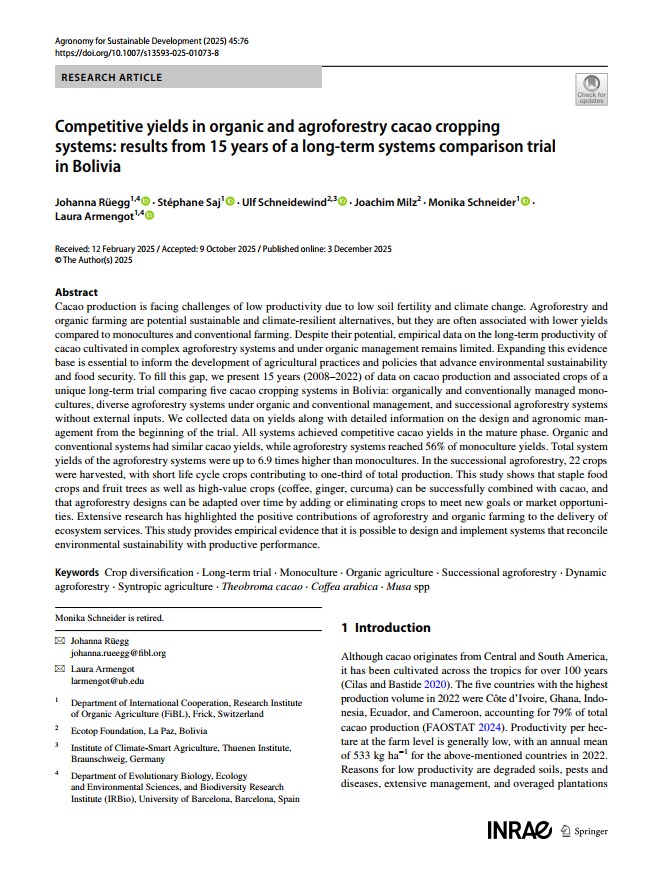
Cette étude présente les données recueillies sur une période de 15 ans (2008-2022) dans le cadre de l'essai à long terme SysCom mené en Bolivie. Les chercheurs ont comparé cinq systèmes de culture du cacao : des monocultures conventionnelles et biologiques, des systèmes agroforestiers conventionnels et biologiques, ainsi que des systèmes agroforestiers en succession sans apports externes.
Au cours de la phase de maturité (2017-2022), les systèmes biologiques et conventionnels ont atteint des rendements en cacao similaires. Les monocultures ont affiché un rendement moyen de 1 300 kg/ha. Les systèmes agroforestiers ont affiché un rendement moyen de 736 kg/ha, soit 561 TP3T du rendement des monocultures. Cet écart est resté constant tout au long de l'étude.
Il convient de noter que ce système de succession ne nécessitait aucun apport extérieur. Il parvenait néanmoins à égaler les rendements des autres systèmes agroforestiers, dès lors que les agriculteurs réduisaient la densité des arbres d'ombrage et intensifiaient la taille.
Les rendements en cacao ne reflétaient qu'une partie de la réalité. Les systèmes agroforestiers ont produit globalement bien plus de denrées alimentaires. Deux systèmes ont généré des rendements totaux jusqu’à 6,9 fois supérieurs à ceux des monocultures, principalement grâce à la banane. Le système de succession a produit des rendements totaux 3,3 fois supérieurs, avec la récolte de 22 cultures différentes sur 15 ans. Le cacao représentait moins de 10% du rendement commercialisable total de l’ensemble des systèmes agroforestiers.
Ces résultats montrent que des systèmes agroforestiers diversifiés et denses peuvent permettre d'obtenir des rendements de cacao compétitifs. Ils peuvent également produire un volume total de denrées alimentaires par hectare bien supérieur à celui des monocultures — même sans apports externes — dès lors que les agriculteurs optimisent leur gestion, notamment la taille d'ombrage.