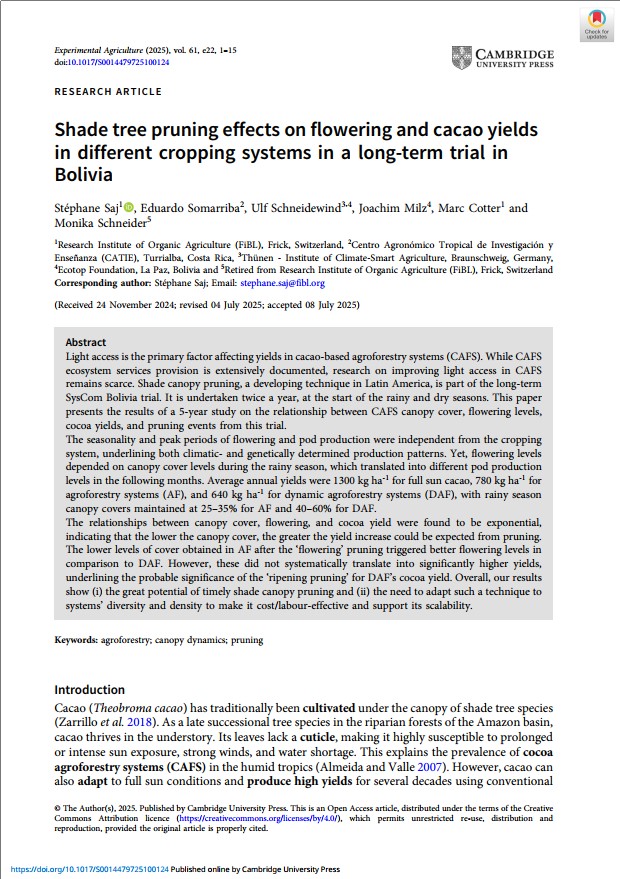
Los investigadores llevaron a cabo un ensayo de cinco años sobre el cacao en Bolivia en el que compararon tres sistemas: el monocultivo a pleno sol, la agrosilvicultura (AF) y la agrosilvicultura dinámica (DAF). El monocultivo produjo los rendimientos más altos, con 1.300 kg/ha. El AF produjo 780 kg/ha y el DAF, 640 kg/ha.
La cobertura del dosel explicaba estas diferencias. El sistema AF mantuvo una cobertura de entre 25 y 351 TP3T durante la temporada de lluvias, mientras que el sistema DAF mantuvo una cobertura de entre 40 y 601 TP3T. La relación entre la cobertura del dosel y tanto la floración como el rendimiento era exponencial, no lineal. Esto significa que pequeñas reducciones en la cobertura producían mayores aumentos de rendimiento en sistemas con una sombra ya de por sí escasa.
La menor cobertura del dosel del sistema AF favoreció la floración en mayor medida que la del sistema DAF. Sin embargo, esto no se tradujo de forma sistemática en mayores rendimientos, lo que pone de manifiesto la importancia añadida de la poda tardía para el DAF. Los momentos de floración y maduración siguieron los patrones estacionales de precipitaciones y se mantuvieron constantes en los tres sistemas, determinados principalmente por el clima y la genética, más que por el propio sistema de cultivo. Fueron los niveles generales de sombra, y no el momento, los que determinaron el grado de floración.