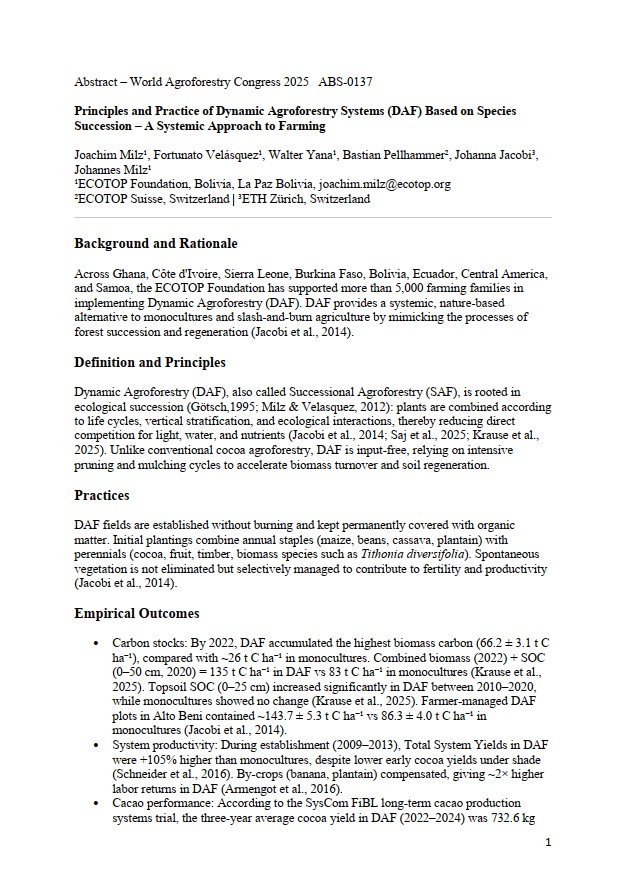
La Fondation ECOTOP a apporté son soutien à plus de 5 000 familles d’agriculteurs dans huit pays, parmi lesquels le Ghana, la Côte d’Ivoire, la Sierra Leone, le Burkina Faso, la Bolivie, l’Équateur, l’Amérique centrale et les Samoa. Tous ces pays mettent en œuvre l’agroforesterie dynamique (DAF), un système inspiré de la succession forestière.
La méthode DAF regroupe les plantes en fonction de leur cycle de vie et de leur strate verticale. Cette conception permet de réduire la concurrence pour la lumière, l'eau et les nutriments. Le système repose entièrement sur la taille et le paillage. Il ne nécessite aucun apport extérieur.
Les résultats en matière de stockage du carbone sont remarquables. En 2022, les parcelles DAF contenaient 66,2 t C/ha de carbone dans la biomasse. Les monocultures n’en contenaient quant à elles qu’environ 26 t C/ha. La somme du carbone de la biomasse et du carbone du sol atteignait 135 t C/ha dans les DAF, contre 83 t C/ha dans les monocultures. Le carbone de la couche arable a considérablement augmenté dans les DAF entre 2010 et 2020. Les monocultures n’ont quant à elles affiché aucune évolution au cours de la même période. Les parcelles DAF gérées par les agriculteurs dans la région d’Alto Beni présentaient des niveaux encore plus élevés, atteignant 143,7 t C/ha contre 86,3 t C/ha dans les monocultures.
Les résultats en matière de productivité sont également favorables au DAF. Au cours de la phase de mise en place, de 2009 à 2013, les rendements totaux du système DAF ont dépassé ceux des monocultures de 1 051 TP3T. Les rendements en cacao étaient initialement plus faibles sous l'ombrage. Des cultures associées telles que la banane et la banane plantain ont permis de compenser cette différence. Le rendement en main-d'œuvre dans le DAF a atteint environ le double de celui de la monoculture.
Les données récentes sur le cacao confirment ces bons résultats. De 2022 à 2024, les rendements de cacao DAF se sont élevés en moyenne à 732,6 kg/ha. Ces résultats ont été obtenus sans aucun intrant externe. Les rendements ont augmenté chaque année au cours de cette période.
Les résultats concernant l'eau et la biodiversité viennent étayer ces conclusions. Les systèmes DAF ont mieux amorti les fluctuations d'humidité du sol que les monocultures. L'utilisation de l'eau par les racines semblait complémentaire entre les différentes strates végétales. Les communautés d'oiseaux présentes dans les systèmes DAF correspondaient à celles observées dans les jachères forestières secondaires.