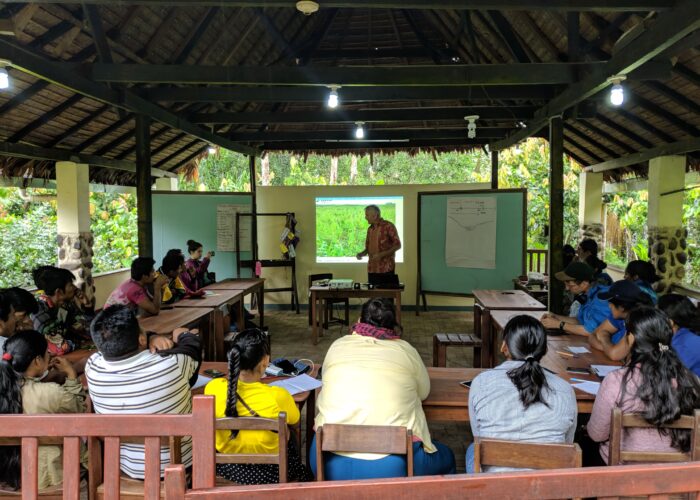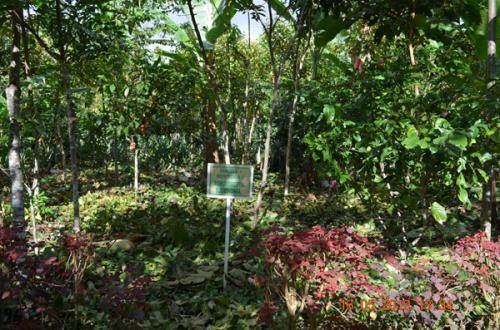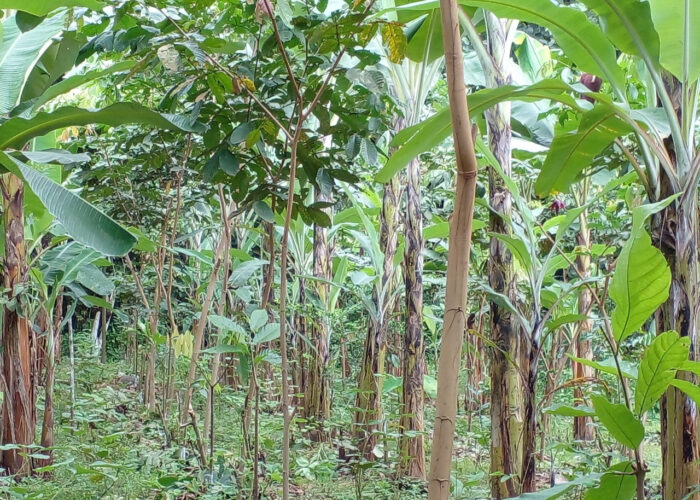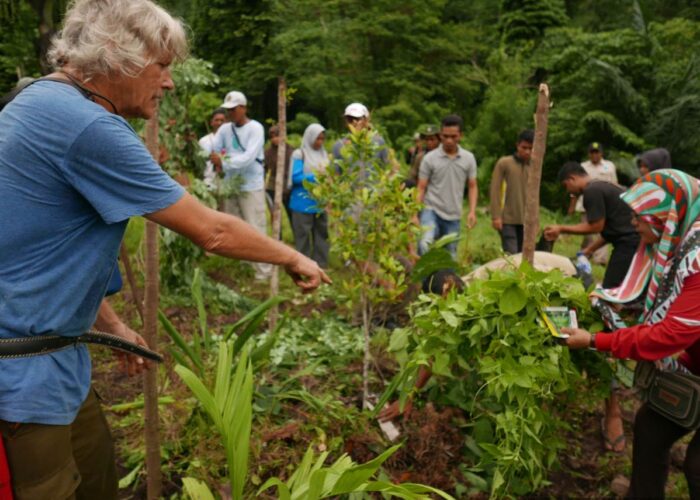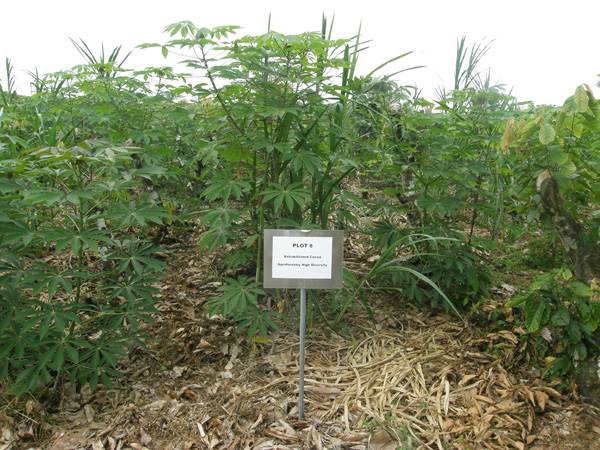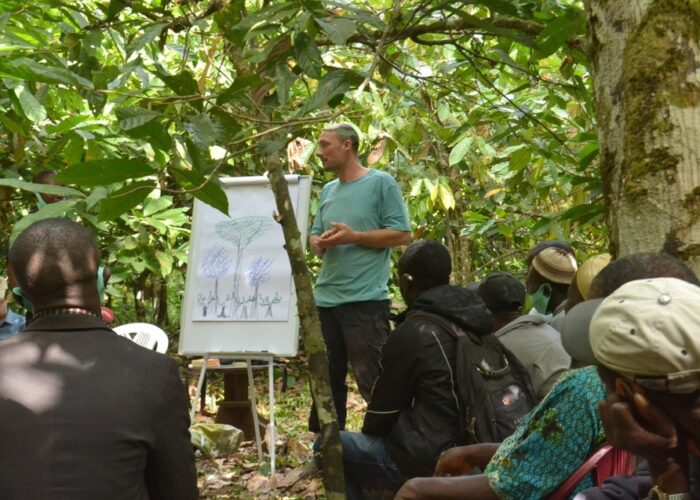
Dynamic Agroforestry (DAF) is an innovative approach to agriculture that integrates diverse plant species in a synergistic, stratified, diverse and dense manner, creating productive and resilient farming systems. In the cocoa industry, DAF offers a sustainable alternative to traditional monoculture practices, enhancing biodiversity, improving soil health, and increasing farmers’ resilience to climate change.
The cocoa industry faces multiple urgent challenges, including deforestation, soil degradation, low yields, and heightened vulnerability to climate change.
Cocoa production is a significant driver of environmental destruction, particularly in West Africa — the world’s largest cocoa-producing region. In Côte d’Ivoire, Ghana, and Cameroon, cocoa cultivation is responsible for over 60% of agri-commodity-driven deforestation, leading to widespread biodiversity loss and contributing substantially to greenhouse gas (GHG) emissions. [1]
Cocoa trees are highly vulnerable to pests and diseases, which can drastically reduce yields. Plant diseases alone account for approximately 38% of global cocoa production losses, making them one of the industry’s most critical threats. [1]
Further problems: [2]
These environmental and agronomic challenges directly impact cocoa farmers, causing volatile incomes and exacerbating economic instability in countries where cocoa is a vital cash crop and a cornerstone of the national economy.
Dynamic Agroforestry (DAF) presents a multifaceted approach to tackling the challenges facing cocoa production, aligning with broader goals of agroforestry and sustainability.
By integrating native trees and plants into cocoa farms, DAF not only promotes biodiversity recovery and reduces pressure on natural forests but also combats soil degradation. The diverse root systems and organic matter introduced through DAF methods improve soil structure and minimize erosion. A notable example of successful biodiversity and soil restoration through DAF is the collaborative research project with FiBL SysCom in Bolivia. [3]
Effective pest and disease management is essential for securing cocoa yields and farmers’ livelihoods. DAF systems foster habitats for beneficial insects, naturally reducing the spread of cocoa-specific pests and diseases in line with integrated pest management and biocontrol strategies. The Sankofa 2.0 project highlights DAF’s role in restoring degraded lands affected by Cocoa Swollen Shoot Virus Disease (CSSVD). Similar evidence show the projects with FiBL in Bolivia and with CRIG in Ghana. [3, 4, 14]
As a climate-smart approach, DAF enhances cocoa farms’ resilience to climate change by creating shaded microclimates, preserving soil moisture, and helping cocoa trees withstand drought and temperature fluctuations. In Borneo, ECOTOP and GIZ have introduced DAF methods to improve regional conservation efforts and support climate mitigation goals through carbon sequestration.[5]
The adoption of sustainable farming practices, such as cocoa agroforestry, can also enhance long-term farmer livelihoods by diversifying income sources with additional crops like fruits, nuts, and medicinal plants, reducing dependency on cocoa alone, and improving soil health.
While the environmental and economic benefits are clear, it’s important to consider labor practices, fair wages, and community development within cocoa-growing regions as critical factors for ensuring long-term social sustainability.
In essence, cocoa agroforestry acts as a mitigation strategy that hints at the potential for more sustainable farming practices that could improve long-term farmer livelihoods by diversifying income sources and improving soil health.
In cocoa farming, Dynamic Agroforestry involves the strategic combination of different plant species with cocoa trees. This method goes beyond simple shade tree planting by creating complex, multilayered ecosystems. The key elements of DAF in cocoa farming include:
Planting species of different heights and growth cycles, such as timber trees, fruit trees, shrubs, and ground cover plants, to mimic natural forest structures.
Introducing fast-growing pioneer species that provide shade and soil improvement, followed by slower-growing trees and permanent crops like cocoa.
Selecting plants that provide multiple ecosystem services, such as nitrogen fixation, pest control, and soil moisture retention.
Regular pruning, selective thinning, and replanting to maintain balance and productivity over time.
Dynamic Agroforestry (DAF) offers a compelling alternative to conventional farming through its integrated and environmentally conscious approach.
Unlike the monocultures often seen in conventional farming, DAF incorporates a variety of plant species, thereby enhancing ecosystem resilience. This biodiversity extends to the soil, where diverse root systems improve structure and fertility. Pruning material plays a crucial role in improving soil fertility and nutrient availability, as it is added continuously as mulch to the soil.
The natural balance fostered in DAF systems also aids in pest and disease management by supporting natural pest control mechanisms, further decreasing the need for pesticides.
Beyond its ecological benefits, DAF allows farmers to diversify their income streams by harvesting multiple products such as fruits and timber, contributing to economic stability.
Finally, by mimicking natural forests, DAF practices significantly reduce deforestation and actively aid in carbon sequestration.
Not only Dynamic Agroforestry, but agroforestry in all its facettes has been examined and validated. Research underscores the efficacy of agroforestry in enhancing cocoa production sustainability:
Several countries have made significant strides in adopting agroforestry practices in cocoa cultivation:
ECOTOP has been instrumental in advancing DAF practices across various cocoa-producing regions. Additionally to the projects mentioned above, ECOTOP has a long track record of DAF in the cocoa industry, for example:
Dynamic Agroforestry (DAF) presents a transformative shift in the cocoa industry, offering sustainable solutions to pressing environmental challenges and simultaneously improving farmer livelihoods. While the prevalence of monocultures remains a significant reality, a growing body of scientific studies and successful projects worldwide validates the multifaceted benefits of DAF, positioning it as a demonstrably viable path towards a more resilient and truly sustainable cocoa sector.
[1] https://link.springer.com/article/10.1186/s43170-024-00310-6
[4] https://ecotop.org/projects/scaling-sustainable-cocoa-farming-in-ghana-sankofa-2-0/
[6] https://orgprints.org/39195/
[7] https://www.nature.com/articles/s41598-023-41593-5
[8] https://link.springer.com/article/10.1007/s10457-024-01041-3
[11] https://ecotop.org/project_tag/cote-divoire/
[15] https://www.sciencedirect.com/science/article/pii/S0167880925003524
[16] https://www.thelancet.com/journals/lanplh/article/PIIS2542-5196(25)00047-6/fulltext