Reforesting With Cocoa: The Promise of Dynamic Agroforestry

What if cocoa farming could be more than just sustainable — what if it could actively restore forests?

A 14-year field experiment in Alto Beni, Bolivia, shows that Dynamic Agroforestry (DAF) can do exactly that. By combining high tree density, species diversity, and regular pruning, DAF turns cocoa plots into regenerating ecosystems that act like young forests — absorbing carbon, building biomass, and boosting biodiversity — all while producing cocoa.
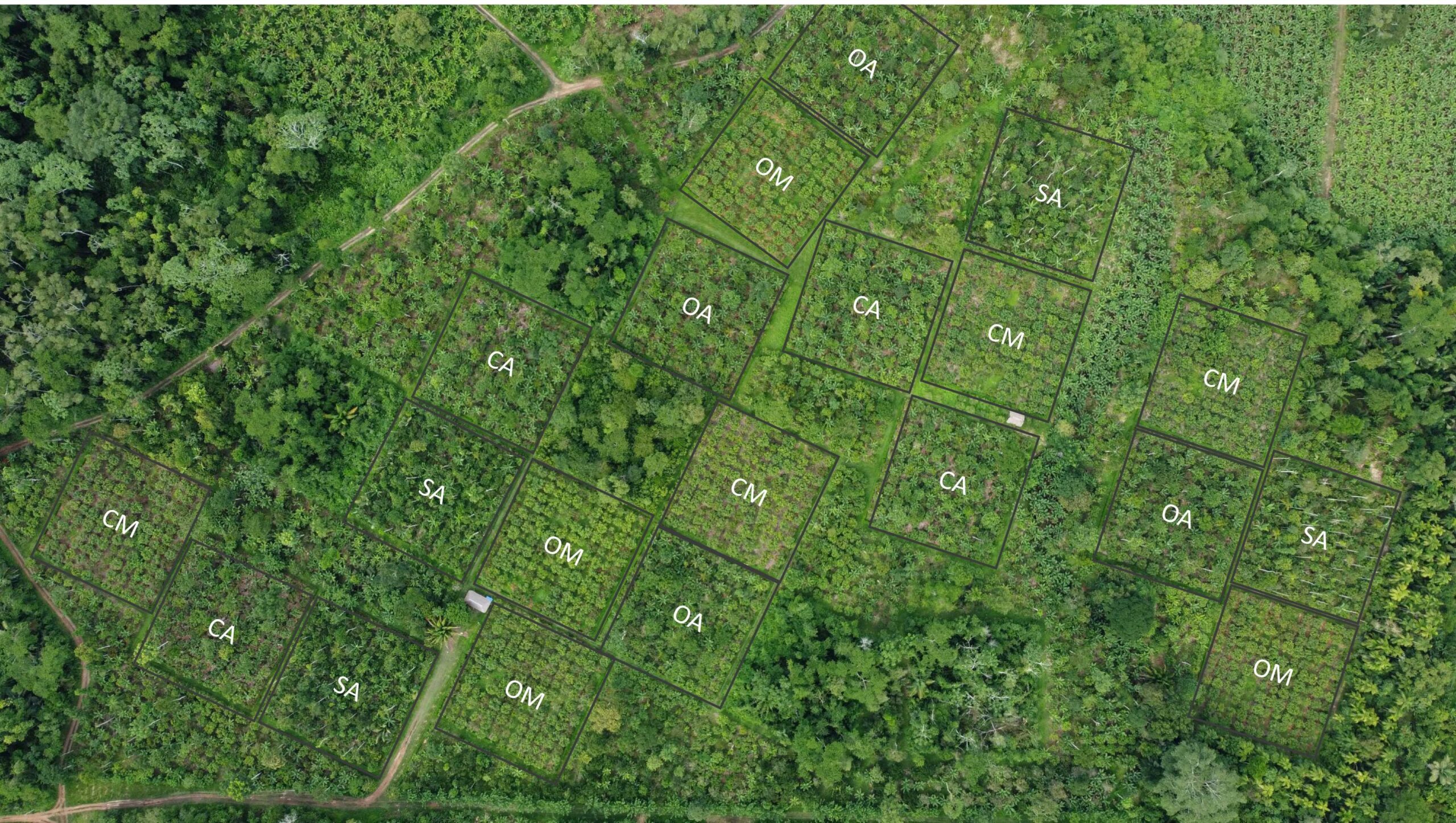
Drone image of a long-term cocoa production trial in Alto Beni, Bolivia, comparing five systems: conventional monoculture (CM), organic monoculture (OM), conventional agroforestry (CA), organic agroforestry (OA), and dynamic agroforestry (SA).
Drone photograph of the 14-year SysCom field trial in Alto Beni, Bolivia, showing plots of conventional and organic monocultures, conventional and organic agroforestry, and successional agroforestry (SA| DAF).

Key Findings – DAF Leads in Biomass Carbon

1. Biomass Carbon More Than Doubled

After 14 years, DAF (SA) stored 66 t C ha⁻¹ of biomass carbon — more than twice the amount stored in conventional monocultures (~26 t C ha⁻¹).

2. Achieved With Zero External Inputs

No compost, no fertilizers, no pesticides — DAF relies entirely on dense planting, natural regeneration, and pruning cycles to build biomass and sustain productivity.

3. Tree Diversity and Density Drive the Results

More than 70% of the stored carbon came from shade and companion trees, showing that mimicking natural forest succession is the key to turning cocoa farming into a reforestation strategy.
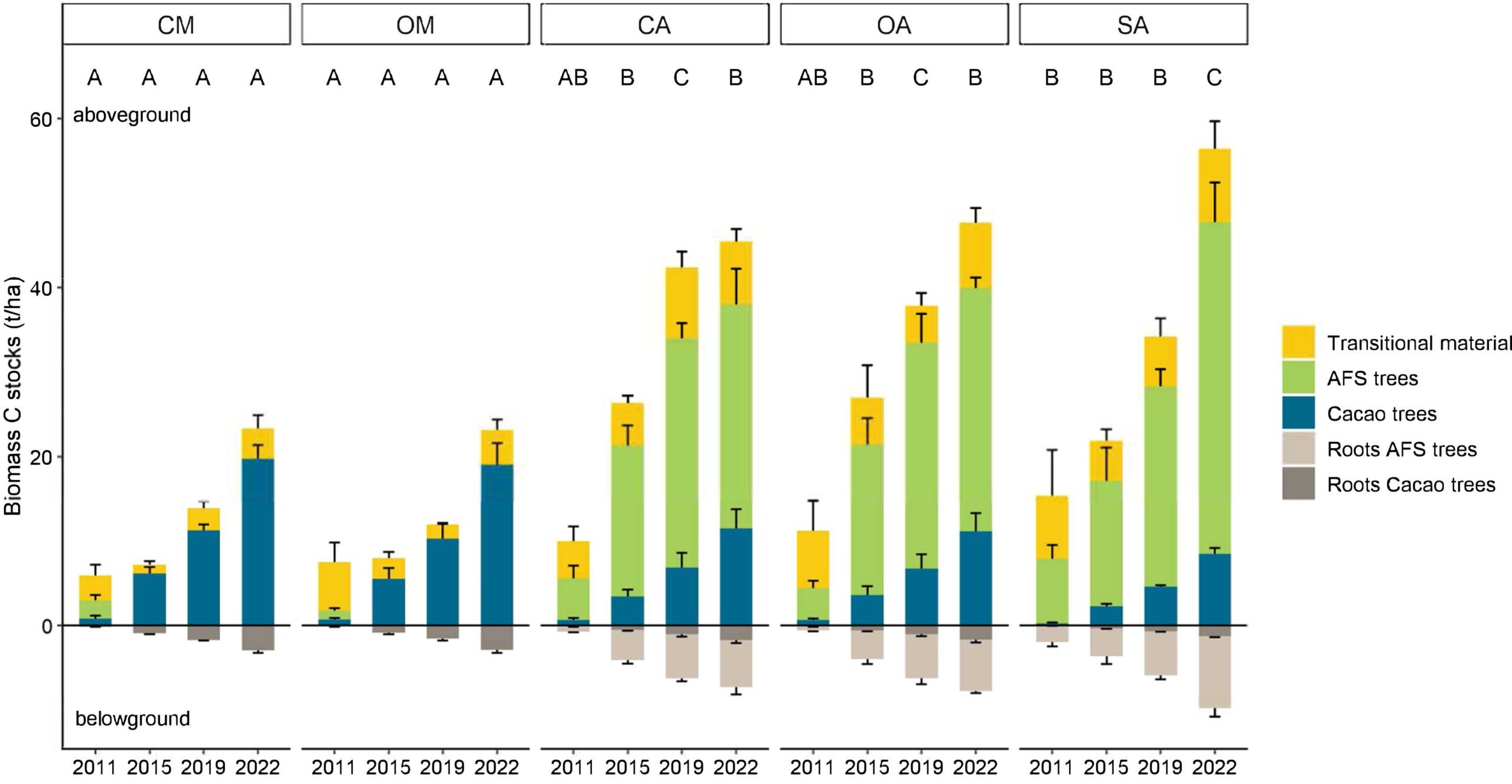
Bar chart showing biomass carbon stocks (t/ha) from 2011 to 2022 in five cocoa production systems: conventional monoculture (CM), organic monoculture (OM), conventional agroforestry (CA), organic agroforestry (OA), and dynamic agroforestry (SA). DAF (SA) shows the highest biomass carbon by 2022.
Above- and below-ground biomass carbon stocks measured over 14 years in the SysCom Bolivia trial. Dynamic Agroforestry (SA) more than doubled biomass carbon compared to monocultures, reaching over 66 t C ha⁻¹ by 2022.

Why DAF Works

DAF imitates the way natural forests grow:

  • Dense and Diverse Planting – fast canopy closure and biomass growth.

  • Regular Pruning and Thinning – stimulates regrowth, channels carbon into woody biomass, and feeds the soil.

  • Zero External Inputs – soil fertility is built through organic matter from the system itself.

This approach keeps the agroecosystem in a productive, carbon-absorbing state and creates a living, multi-strata system that behaves like a forest — but with cocoa at its core.

Cocoa as a Climate Solution

Instead of being associated with deforestation, cocoa production in DAF systems becomes a driver of reforestation. These systems remove CO₂ from the atmosphere, rebuild soil health, and generate income for farmers — showing that climate mitigation and profitable cocoa production can go hand in hand.

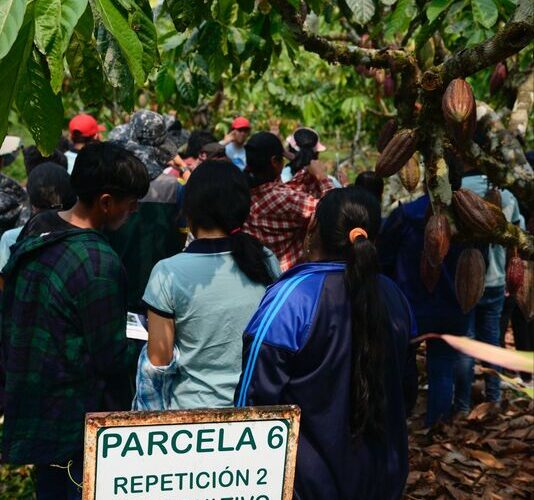
Dynamic Agroforestry (DAF) cocoa system in Bolivia with nearly 1 t/ha of cocoa yield, demonstrating high productivity alongside biodiversity and carbon sequestration.
Cocoa agroforestry plot in Bolivia managed under Dynamic Agroforestry principles, reaching close to 1 ton per hectare of cocoa yield.

From Research to Action: Tailored Climate Projects

At ECOTOP, we help companies and cooperatives turn these insights into action. We design tailored climate projects that integrate Dynamic Agroforestry (DAF) into cocoa supply chains — from baseline assessments and ex-ante carbon modeling to farmer training and field implementation. Our approach ensures credible, science-based results that reduce supply chain emissions while supporting farmer livelihoods.
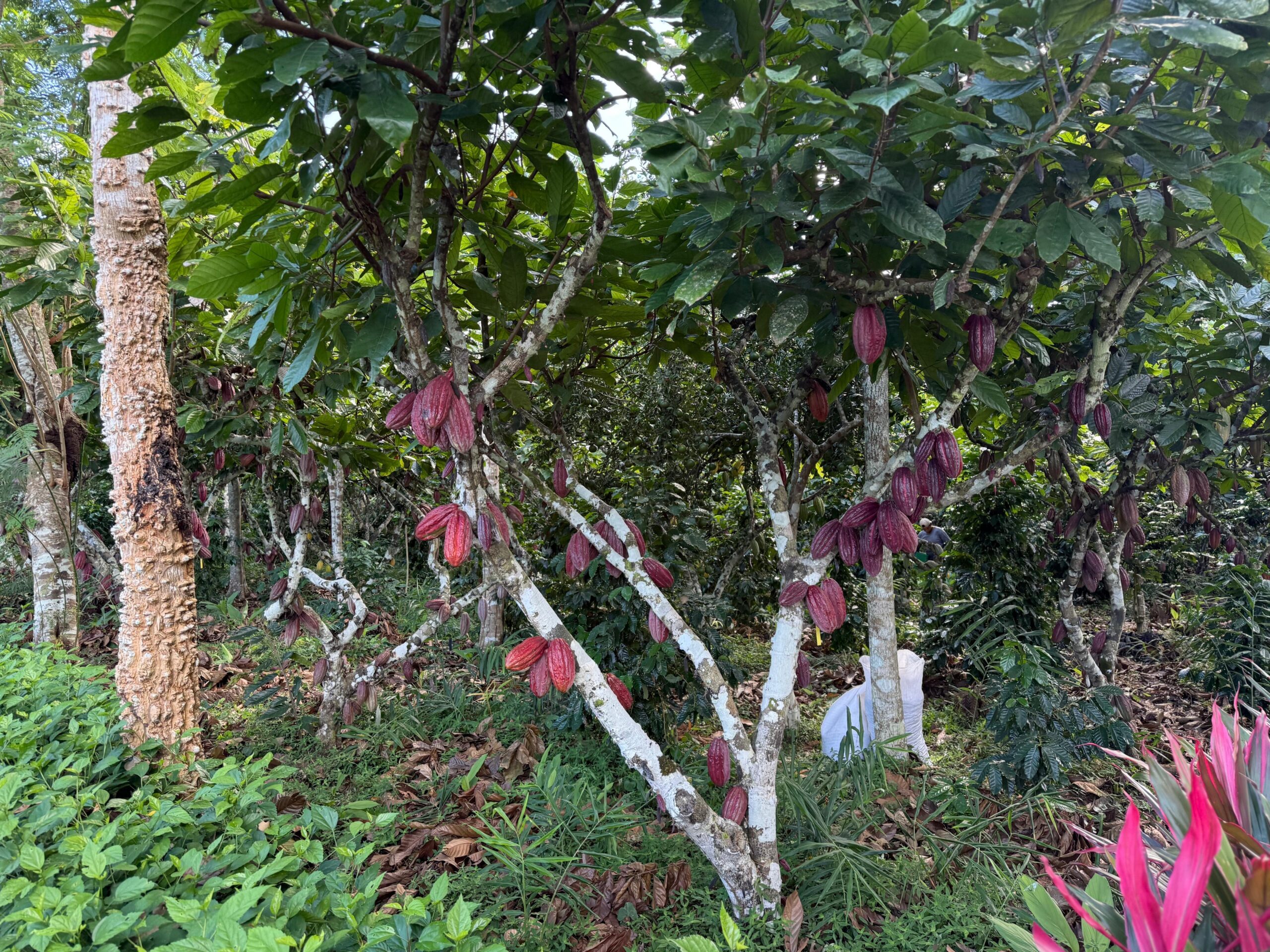
Dynamic Agroforestry cocoa plot in Bolivia with heavy pod production, showing diverse vegetation and shade management for high productivity and carbon sequestration.
A productive Dynamic Agroforestry (DAF) cocoa system in Bolivia, where cocoa trees are integrated with diverse shade and companion plants, producing nearly 1 t/ha of cocoa.

Sources

  • Krause, H. M., Saj, S., Rüegg, J., Schneidewind, U., Lory, S., Cotter, M., J., Milz., & Armengot, L. (2025). Successional agroforestry promotes biomass carbon storage in cocoa production systems: results from a long-term system comparison experiment on organic and conventional systems. Agriculture, Ecosystems & Environment, 393, 109820.

Full Article: https://www.sciencedirect.com/science/article/pii/S0167880925003524
Want to read more?

Take a glimpse at our work

Dynamic Agroforestry in your supply chain?

Yes, that's possible! Don't hesitate to contact us.