Yield Optimization with Dynamic Agroforestry: Beyond Single Crop Maximization

Conventional agricultural practices typically focus on maximizing the yield of a single crop through monoculture. While this approach may offer short-term productivity, it demands high inputs such as intensive land preparation, synthetic fertilizers, herbicides, and pesticides. In contrast, Dynamic Agroforestry (DAF) presents an integrated approach, leveraging ecological principles to enhance overall productivity, reduce external inputs, and provide extensive ecosystem services.


Yield Optimization through Biodiversity

Dynamic Agroforestry strategically integrates diverse crops, allowing simultaneous growth and multiple harvests. This technique not only reduces input requirements but consistently outperforms monoculture in total system yield. Central to understanding this advantage is the Land Equivalent Ratio (LER).


Understanding Land Equivalent Ratio (LER)

LER compares the total productivity of a mixed cropping system against monoculture yields. For example, in the classic “Three Sisters” system of maize, beans, and squash:

  • Maize, spaced to allow adequate sunlight penetration, might yield 60% of its monoculture potential.
  • Beans, planted less densely to prevent shading maize excessively, produce 50% compared to monoculture.
  • Squash, shaded by taller plants, achieves about 40% of its monoculture yield.

Combined, this polyculture yields an equivalent of 150% (LER = 1.5), indicating significant productivity advantages over monoculture
Key Benefits of Dynamic Agroforestry

Higher Total System Yields

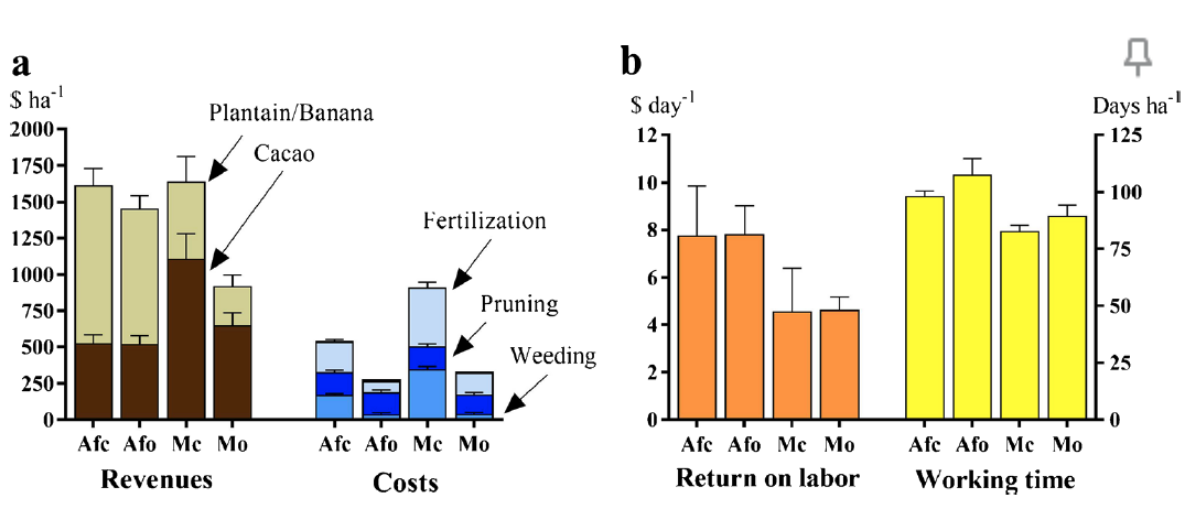
Bar graphs comparing revenues, costs, return on labour and working time across four cacao agroforestry management systems (Afc, Afo, Mc and Mo). The first graph (a) shows revenues by crop type (cacao and plantain/banana) and costs by activity (weeding, pruning and fertilisation). The second graph (b) shows the return on labour ($/day) and working time (days/ha) for each system.
Figure 1: Annual mean ± standard error from 2010 to 2014 of return on labor and working time in four production systems—agroforestry conventional (Afc), agroforestry organic (Afo), full-sun monoculture conventional (Mc), and full-sun monoculture organic (Mo). Agroforestry systems show a higher return on labor despite higher total working time compared to monocultures (Armengot et al, 2016).

Enhanced Soil Fertility

  • Diverse root architectures reduce competition, improve soil structure, and enhance microbial activity.
  • Ground-cover plants reduce weed pressure, limiting herbicide usage and protecting against soil erosion.
  • Organic matter production and root penetration improve water quality and moisture retention.

Improved Pest Management

  • Diverse plant species promote natural predator habitats, significantly reducing pest populations without chemical intervention.

Resource Optimization and Reduced Inputs

  • Multi-layered planting optimizes sunlight, water, and nutrient use, reducing wastage.
  • Leguminous plants fix nitrogen naturally, reducing the need for synthetic fertilizers.
  • Biomass from regular pruning cycles serves as natural mulch, further enriching the soil and conserving water.
  • Managing multiple crops synergistically results in higher return on labor (Armengot et al., 2016).

How to Implement Dynamic Agroforestry Successfully

Transitioning to Dynamic Agroforestry requires specialized knowledge of ecological interactions, species selection, and effective management techniques. Our company specializes in comprehensive agroforestry consulting, providing tailored solutions and practical training.

We offer:

  • Detailed assessments of local conditions and optimal crop combinations.
  • Hands-on training workshops for farmers, technical staff, and management teams.
  • Agro-ecosystem design tailored to farmers’ or clients’ needs, with implementation (planting) following best-practice Dynamic Agroforestry (DAF) principles.
    • For example, cocoa can be the main crop, spaced at 3×4 meters, accompanied by other marketable fruit trees or cash crops.
  • Ongoing support and monitoring during the critical initial years of implementation.

Join the Agroforestry Movement

Dynamic Agroforestry is a powerful approach to sustainable agriculture, providing resilience, productivity, and ecological benefits. Contact us today to discover how we can help transform your land, enhance your supply chain sustainability, and support your organization’s goals for environmental responsibility and economic resilience.
Sources

  • (1) Armengot, L., Barbieri, P., Andres, C., Milz, J., & Schneider, M. (2016). “Cacao Agroforestry Systems Have Higher Return on Labor Compared to Full-Sun Monocultures.” Agronomy for Sustainable Development, 36(4), 70. https://doi.org/10.1007/s13593-016-0406-6.
  • (2) Schneider, M., Andres, C., Trujillo, G., Alcon, F., Amurrio, P., Perez, E., Weibel, F., & Milz, J. (2017). “Cocoa and Total System Yields of Organic and Conventional Agroforestry vs. Monoculture Systems in a Long-Term Field Trial in Bolivia.” Experimental Agriculture, 53(3), 351–374. https://doi.org/10.1017/S0014479716000417.
  • (3) Zhang, C., Postma, J. A., York, L. M., & Lynch, J. P. (2014). “Root Foraging Elicits Niche Complementarity-Dependent Yield Advantage in the Ancient ‘Three Sisters’ (Maize/Bean/Squash) Polyculture.” Annals of Botany, 114(8), 1719–1733. https://doi.org/10.1093/aob/mcu191.
  • (4) François, M., Pontes, M. C. G., Da Silva, A. L., & Mariano-Neto, E. (2023). “Impacts of Cacao Agroforestry Systems on Climate Change, Soil Conservation, and Water Resources: A Review.” Water Policy, 25(6), 564–581. https://doi.org/10.2166/wp.2023.164.

Want to read more?

Take a glimpse at our work

Dynamic Agroforestry in your supply chain?

Yes, that's possible! Don't hesitate to contact us.